

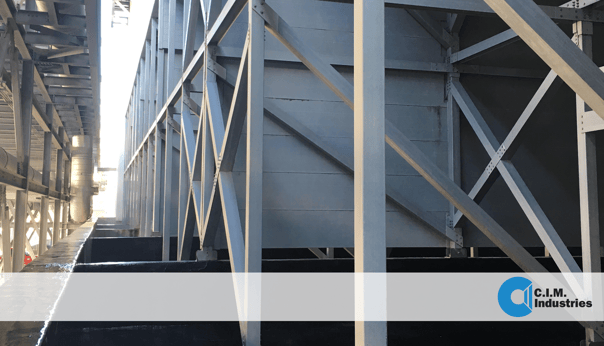
 Cooling tower areas expose rooftop waterproofing to water, vibration, maintenance traffic, and complex mechanical details. Once equipment is installed, even a small leak can be difficult to reach and repair. This article explores why drainage, access, and detailing matter—and how a liquid-applied CIM membrane can protect these areas while allowing localized repairs if damage occurs.
Why Accessibility Becomes a Lifecycle Design Factor
Cooling towers create one of the wettest, and least accessible, environments on a data center roof. Once the steel, piping, platforms, and utility racks are in place, the waterproofing beneath them is no longer just a roof detail.
It is part of the facility’s uptime strategy.
Cooling tower zones combine recurring water exposure, concentrated drainage, vibration, structural movement, maintenance traffic, penetrations, supports, and restricted access. A leak in this environment can become more than a maintenance problem.
It can become an operational risk.
Cooling Towers Create a Different Waterproofing Environment
Cooling tower areas are active mechanical zones where water, movement, and infrastructure converge.
They may be exposed to cooling tower drift, condensation, washdown, discharge, overflow events, thermal cycling, equipment vibration, pipe penetrations, structural supports, curbs, and repeated maintenance activity.
The open field membrane is rarely the most difficult part of the assembly.
The interfaces are the project.
Long-term performance is usually determined at supports, drains, curbs, penetrations, steel frames, utility racks, and changes in elevation. These are the locations where water collects, movement concentrates, and access becomes restricted.
A successful waterproofing strategy must therefore do more than cover the roof surface. It must maintain watertight performance through the mechanical details that define the cooling tower area.
Drainage Determines the Exposure
Cooling towers introduce water beyond ordinary rainfall.
Drift, condensation, washdown, discharge, and occasional overflow can keep the area wet even when the surrounding roof is dry. If drainage is poor, water may remain trapped around supports, curbs, penetrations, and low points.
That turns an intermittent waterproofing condition into a continuous exposure condition.
Positive drainage, maintainable drains, accessible flow paths, overflow management, and coordinated support placement should be treated as part of the waterproofing design.
Even a high-performance membrane cannot compensate indefinitely for standing water, blocked drainage paths, or poorly coordinated elevations.
Poor drainage can turn a durable membrane into a temporary solution.
Accessibility Changes the Cost Equation
Once major cooling equipment is installed, waterproofing inspection and repair become substantially more difficult.
A localized leak may require work around operating equipment, restricted access, temporary protection measures, mechanical coordination, and carefully planned shutdown windows.
The repair material itself is rarely the greatest expense.
The larger cost is locating the leak, reaching the affected area, protecting critical systems, and completing the work without disrupting facility operations.
For that reason, accessibility should influence waterproofing selection from the beginning.
The relevant question is not only whether the membrane can resist water and movement. It is whether the system can remain serviceable after the cooling towers and surrounding infrastructure make future access difficult.
In cooling tower applications, accessibility becomes a lifecycle design factor.
Thousands of Small Movements Matter
Waterproofing beneath cooling towers is rarely challenged by one dramatic movement event.
More often, it is subjected to thousands of small movement cycles over years of operation.
Fans rotate. Pumps cycle. Piping expands and contracts. Equipment starts and stops. Structural members deflect under changing loads. Temperatures rise and fall.
Individually, these movements may be minor.
Collectively, they create cumulative stress at penetrations, supports, flashing transitions, curbs, and drains.
The waterproofing assembly should therefore be evaluated as a long-term movement environment, not simply as a static water barrier.
Weak details can fatigue. Rigid transitions can crack. Poorly bonded areas can become vulnerable. Seams and terminations can be stressed repeatedly.
The system must remain bonded and watertight while the infrastructure above it continues to move.
Why Fully Adhered Liquid-Applied Systems Are Often Considered
High-build, fully adhered liquid-applied elastomeric systems are often considered beneath cooling towers because they can conform to complex geometry and create a bonded waterproofing layer around closely spaced mechanical components.
This is especially valuable where the assembly includes multiple supports, penetrations, curbs, drains, steel members, elevation changes, and retrofit connections.
Potential advantages of this system category include:
- Seamless application
- Adhesion to properly prepared, compatible substrates
- Crack-bridging capability
- Movement accommodation
- Reduced reliance on field seams
- Adaptability around irregular details
- Localized repairability when compatible procedures are followed
CIM high-build urethane systems are one example of this type of technology.
Their value in cooling tower environments lies less in covering large open areas and more in simplifying the interfaces where waterproofing risk is concentrated.
Where CIM Can Provide the Greatest Value
The highest-value use of CIM beneath cooling towers is at complex, tightly spaced mechanical details.
These may include equipment supports, curbs, pipe penetrations, steel frames, utility supports, drains, irregular transitions, retrofit connections, and localized repair areas.
Because CIM is liquid applied, it can conform to the actual geometry of the substrate and form a continuous membrane around details that would otherwise require numerous cuts, laps, seams, or transitions.
That can be particularly useful where multiple mechanical components are installed close together and conventional sheet detailing becomes difficult to execute or inspect.
In these environments, reducing field seams is not simply an installation convenience.
It reduces the number of interfaces that must remain watertight through years of water exposure, movement, vibration, and maintenance activity.
The interfaces are the project.
Everything else is secondary.
Preparation and Detailing Still Control Performance
No waterproofing system can overcome poor substrate preparation or weak detailing.
Cooling tower areas may involve concrete, steel, curbs, repair materials, existing coatings, and transitions between dissimilar substrates. Each condition must be evaluated before installation.
The substrate should be structurally sound, properly prepared, clean, and compatible with the selected system.
Particular attention should be given to cracks, joints, changes in plane, penetrations, drains, equipment supports, curbs, terminations, and existing repairs.
The goal is not simply to coat the surface.
It is to create a complete assembly in which the substrate, details, field membrane, drainage, and protection strategy work together.
Protect the Membrane Before Access Is Lost
Cooling tower waterproofing can be damaged before the facility becomes operational.
Steel erection, piping work, equipment placement, temporary supports, dropped tools, and maintenance traffic can compromise the membrane after installation.
Sequencing and protection are therefore critical.
The waterproofing should be inspected before mechanical infrastructure restricts access. Vulnerable areas should be protected from trade damage, and supports and penetrations should be coordinated as early as possible.
If CIM is damaged during construction or maintenance, the affected area can be repaired locally using the appropriate surface preparation and repair procedures. Catching and repairing damage before equipment restricts access helps keep a small issue from becoming a costly one.
Quality Control Is the Final Opportunity
Quality control is one of the last opportunities to reduce long-term risk before the assembly becomes difficult to reach.
Inspection should address substrate condition, detail treatment, material mixing, application thickness, curing, and protection.
Particular attention should be given to the interfaces that will become inaccessible after cooling tower installation.
Where appropriate, testing can help identify deficiencies before the mechanical buildout is complete.
The timing matters.
Once access is lost, even a small defect can become a major operational problem.
Final Takeaway
Cooling towers combine water, movement, vibration, penetrations, maintenance activity, and limited access in one of the most demanding waterproofing environments on a data center roof.
The field membrane matters, but long-term performance is determined at the interfaces surrounding the mechanical infrastructure.
The strongest strategy treats drainage, movement, adhesion, complex geometry, protection, and future accessibility as one coordinated system.
That is why fully adhered liquid-applied elastomeric systems such as CIM deserve consideration beneath large cooling tower installations—not simply because they protect the roof, but because they help protect the cooling infrastructure that protects the data center itself.
In a mission-critical facility, waterproofing beneath cooling towers is uptime protection.
FAQ
Why is waterproofing important beneath data center cooling towers?
Waterproofing helps manage recurring water exposure, vibration, structural movement, penetrations, maintenance traffic, and restricted access. A leak can become an operational risk.
Why is accessibility a lifecycle design factor?
Once cooling towers and surrounding infrastructure are installed, inspecting and repairing the waterproofing becomes more difficult, expensive, and potentially disruptive.
What causes water exposure around cooling towers?
Cooling tower areas may experience drift, condensation, washdown, discharge, overflow events, and rainfall.
Why is drainage important in cooling tower areas?
Positive drainage helps prevent standing water around supports, curbs, penetrations, drains, and low points. Even a high-performance membrane cannot compensate indefinitely for poor drainage.
Where are cooling tower waterproofing failures most likely to occur?
Risk is concentrated at supports, drains, curbs, pipe penetrations, steel frames, utility racks, terminations, and changes in elevation.
Why are fully adhered liquid-applied systems considered beneath cooling towers?
These systems can conform to complex geometry and create a continuous, bonded waterproofing layer around closely spaced mechanical components.
What are the benefits of CIM high-build urethane systems?
CIM systems offer seamless application, crack-bridging capability, movement accommodation, reduced reliance on field seams, and adaptability around irregular details.
Where can CIM provide the greatest value beneath cooling towers?
CIM can provide value around equipment supports, curbs, pipe penetrations, steel frames, drains, retrofit connections, irregular transitions, and localized repair areas.
How does equipment movement affect waterproofing?
Repeated vibration, thermal cycling, piping movement, and structural deflection can stress penetrations, supports, flashing transitions, curbs, and drains over time.
What quality-control steps are important before access is restricted?
Inspection should address substrate condition, detail treatment, material mixing, application thickness, curing, and protection from construction damage.