Skip to content

  • There are no suggestions because the search field is empty.
CIM Chase logoK_301C (3)

More On Waterproofing The World Trade Center Fountains

Posted by Nick Leuci on 8/27/2018

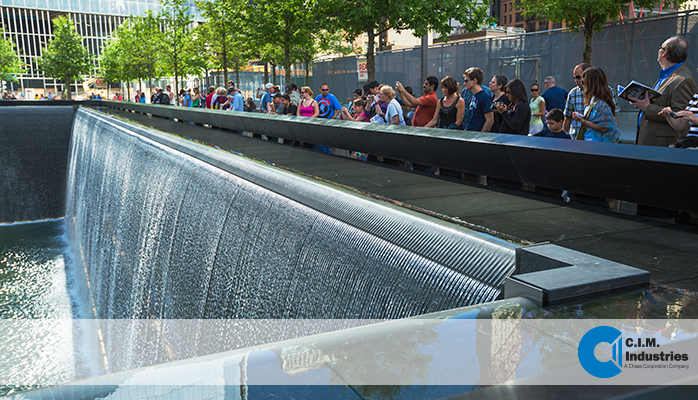
The World Trade Center memorial (WTC) in New York City contains two enormous fountains which presented many waterproofing challenges

The contractor team spent over 18 months installing the concrete waterproofing system that was selected for the job. Here are the methods utilized:

Read More

Topics: Water Features & Fountains, Concrete Waterproofing

Waterproofing The World Trade Center Fountains

Posted by Nick Leuci on 8/09/2018

When designers started to plan what would become North America’s largest man-made waterfalls (World Trade Center Memorial -WTC) in New York City, they faced a number of challenges. One of the biggest concerns was how to contain vast quantities of water while preventing infiltration into underground structures.  

Read More

Topics: Water Features & Fountains, Concrete Waterproofing

The Advantages of Non Glycol Based Urethanes for Waterproofing Applications

Posted by Richard Stephens on 8/14/2017

Polyurethanes are used to make products with properties ranging from soft flexible foams such as memory foam mattresses, to rigid foams used for house insulation. They can be made into soft rubber as used for skateboard wheels or into very hard enamels as used in modern automobile paints.

 The range of properties can be quite wide, just by changing the chemistry a little, but there's a problem. The traditional chemistry uses materials that have an affinity for water. For applications such as fountains, pond liners, waterproofing, water and waste water tanks, roofing — where long term or constant immersion is an essential requirement — that affinity for water will lead, eventually, to the product swelling or even failing. The reason is in the chemistry, itself. Here’s why.

Read More

Topics: Water Features & Fountains

Subscribe Here!

Featured posts