


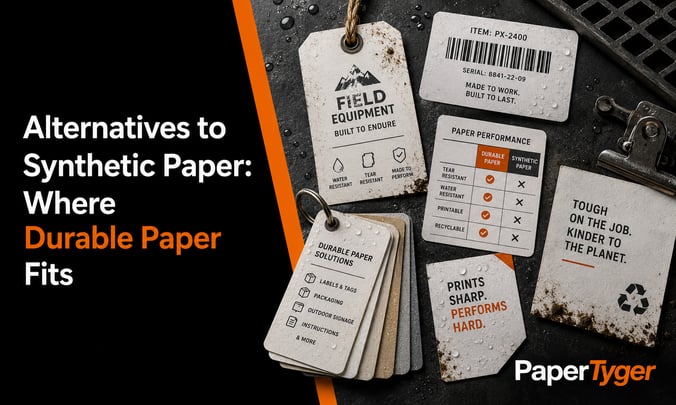
Fully synthetic materials are often used when durability is critical - resisting tearing, moisture, and environmental exposure. But they also introduce trade-offs. Printing requirements can change. Workflows may become more complex. And the material itself behaves differently from paper. For many applications, the goal is not maximum durability at any cost, but comparable performance without unnecessary complexity.
What Fully Synthetic Paper Solves
Fully synthetic materials are typically selected for:
- High tear resistance
- Moisture and weather exposure
- Long-term outdoor durability
- Resistance to demanding environments
Trade-Offs of Fully Synthetic Materials
While effective, fully synthetic materials can introduce challenges:
- Print adjustments or specialized inks
- Handling differences during finishing
- Material feel that differs from paper
- Higher cost in some applications
For operations focused on efficiency and consistency, these trade-offs can become significant.
Where PaperTyger Durable Paper Fits
PaperTyger durable paper provides an alternative for applications that require strength and resistance, while delivering performance equivalent to fully synthetic materials in many real-world use cases.
It is designed to:
- Deliver tear and moisture resistance
- Maintain compatibility with standard print equipment
- Preserve a paper-like surface and feel
- Simplify production workflows
PaperTyger performance is supported by real-world testing, including tear resistance, water exposure, and UV performance evaluations. This makes it a strong option for a variety of applications from various industries.
Durable Paper vs Fully Synthetic Materials
|
Factor |
Durable Paper |
Fully Synthetic Materials |
|
Print compatibility |
Standard equipment |
May require adjustments |
|
Workflow complexity |
Low |
Higher |
|
Material feel |
Paper-like |
Plastic-like |
|
Durability |
High (most use cases) |
Very high (prolonged conditions) |
The choice often depends on balancing performance with operational efficiency.
Where Substitution Works Best
Durable paper is a strong fit when:
- Materials are handled frequently
- Moisture or grease resistance is required
- Maintaining standard print workflows is important
- A paper-like appearance, writability, and ease of finishing are valued
Typical substitution scenarios include:
- Hospitality materials such as menus and door hangers, which are often laminated or printed on fully synthetic stocks, can be produced with durable paper while maintaining performance and simplifying production (see à Door Hangers Case Study)
- Labels and tags, where durable paper can often replace fully synthetic stocks while delivering the strength, printability, and handling performance required for day-to-day use.
- Packaging and printed materials, where durability is needed without adding extra process steps, specialized handling, or a plastic-like surface
From Material Choice to Workflow Efficiency
For many buyers, the decision is not just about material properties, but how those materials affect production.
PaperTyger durable paper offers:
- Reduced process complexity
- Consistent print performance
- Greater flexibility for short runs and updates
This can make a measurable difference in day-to-day operations.
Evaluate the right material for your application:
-
View Product Options → https://chasecorp.com/brands/papertyger
Please note: As of April 28, 2026, all PaperTyger® carton sales are managed through Wausau Coated Products, the sole authorized distributor for PaperTyger carton products.
What are alternatives to synthetic paper?
Alternatives to synthetic paper include durable paper materials that provide tear resistance, moisture tolerance, and print compatibility on standard equipment. Durable paper is often the preferred choice when performance is required without the added complexity of synthetic materials or lamination processes.
FAQ:
What is PaperTyger made of?
PaperTyger is made using a paper–film–paper construction, combining two outer paper layers with an internal film layer.
Can durable paper replace synthetic materials?
In many applications, yes - particularly in applications where it can deliver comparable performance without the added complexity of synthetic materials.
Does durable paper contain plastic?
PaperTyger includes an internal film layer but is not a fully synthetic material.
Is durable paper suitable for outdoor use?
It can be used in some outdoor environments, but long-term exposure should be evaluated.
Which is more cost-effective: durable paper or synthetic paper?
It depends on the application, but durable paper can reduce overall costs by simplifying production and avoiding specialized processes.