


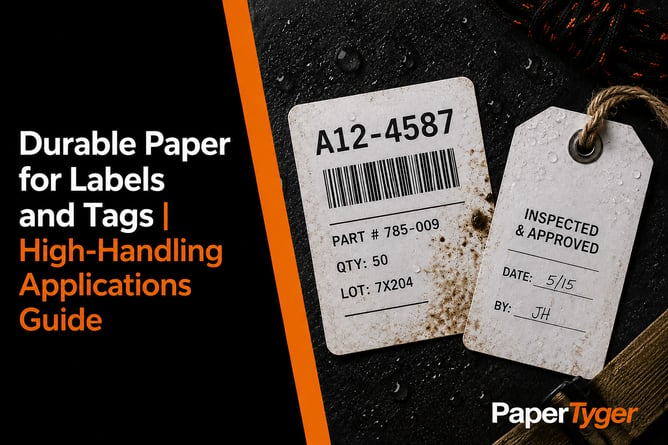
Labels and tags are often expected to perform in demanding conditions, exposed to handling, moisture, abrasion, and environmental stress. Traditional paper can fail quickly in these environments, while synthetic materials introduce their own trade-offs, including cost, print complexity, and workflow adjustments. PaperTyger durable paper offers a middle ground: a material that behaves like paper in production but delivers performance comparable to synthetics in many use cases.
Common Failure Points in Labels and Tags
Standard paper labels and tags typically fail in predictable ways:
- Tearing during handling or transport
- Degradation from moisture or humidity
- Surface wear from abrasion or friction
- Ink performance issues under stress conditions
In environments like logistics, warehousing, or horticulture, these issues can lead to lost information, rework, and operational inefficiencies.
Where PaperTyger Durable Paper Fits
PaperTyger durable paper is designed to address these failure points while maintaining compatibility with conventional print workflows.
Typical use cases include:
Logistics and Warehousing
- Shipping tags
- Inventory tags and labels
- Pick-and-pack identification
- Packaging identification, including board mailers
Horticulture and Agriculture
- Plant tags exposed to water and outdoor conditions
- Long-life labeling in nurseries and garden centers
- Applications where thermal and UV performance matter
(see -> Printing Hang Tags to Last: Thermal and UV Testing)
Industrial and Demanding Environments
- Work-in-progress tags
- Equipment labeling
- Temporary but durable identification
- Field documentation and jobsite tags
Product and Packaging Applications
- Product tags and labels
- Packaging components requiring durability and print quality
- Consumer-facing materials such as soap wrappers or record labels (see -> Discover the Ultimate Record Label Paper: PaperTyger)
In these scenarios, materials need to withstand handling and exposure without introducing unnecessary complexity into production.
Print Compatibility and Workflow Advantages
One of the key advantages of durable paper is its compatibility with standard equipment.
Unlike many synthetic materials, it does not typically require:
- Specialized inks
- Modified press settings
- Extended drying times
This allows printers and converters to:
- Work within existing production setups
- Reduce setup time
- Avoid introducing new variables into production
For operations managing multiple SKUs or short runs, this consistency is particularly valuable.
Handling and Lifespan Expectations
PaperTyger durable paper is designed to extend the usable life of labels and tags in real-world conditions.
It offers:
- Improved tear resistance compared to traditional paper
- Resistance to moisture and environmental exposure
- Durability under repeated handling
Durable Paper vs Synthetic Materials (for Labels and Tags)
For label and tag applications specifically, the comparison is less about maximum durability and more about balancing performance with workflow.
Synthetic paper is often selected for maximum durability, particularly in environments with long-term outdoor exposure or extreme conditions.
However, for many applications, the decision is not about achieving the highest possible durability but about selecting the right level of performance without introducing unnecessary complexity.
Durable paper provides that balance.
It delivers performance that can rival synthetics in many high-handling environments, while maintaining compatibility with standard printing and finishing processes.
Key Differences in Practice:
|
Consideration |
Durable Paper |
Synthetic Paper |
|
Print workflow |
Runs on standard equipment |
May require adjustments |
|
Production complexity |
No additional steps |
Often higher |
|
Material feel |
Paper-like, writable |
Plastic-like surface |
|
Consideration |
Durable Paper |
Synthetic Paper |
|
Durability |
High for most use cases |
Designed for extreme conditions |
In practice, this means PaperTyger durable paper is often the better choice when workflow simplicity, print compatibility, and material feel matter alongside performance.
Choosing the Right Material
Durable paper is a strong fit when:
- You need improved durability without switching to synthetic materials
- Maintaining typical printing methods is important
- Labels or tags are handled frequently and may be exposed to demanding indoor or outdoor conditions
- You want a paper-like appearance and finish
Synthetic materials remain appropriate for:
- Long-term outdoor exposure
- Chemical resistance requirements
Discover our durable paper for labels and tags:
- Request PaperTyger Samples → https://www.wausaucoated.com
Please note: As of April 28, 2026, all PaperTyger® carton sales are managed through Wausau Coated Products, the sole authorized distributor for PaperTyger carton products.
What is the best material for durable labels and tags?
The best material for durable labels and tags depends on the environment, but durable paper is often a strong alternative to synthetic materials. It provides tear resistance, moisture tolerance, and print compatibility on standard equipment, while simplifying production by avoiding specialized materials or processes.
FAQ:
Can durable paper replace synthetic label materials?
In many cases, yes. Durable paper can replace synthetic materials for applications that require strength and moisture resistance without extreme environmental exposure.
Are durable paper labels waterproof?
Durable paper offers water resistance suitable for many environments, though full waterproofing depends on the specific use case.
Can durable paper be used outdoors?
It can be used in certain outdoor applications, such as horticulture, but long-term exposure conditions should be evaluated.
Does durable paper require special printing equipment?
No. It is designed to run on standard digital, offset, and inkjet printing equipment.
Does durable paper contain plastic?
PaperTyger includes an internal film layer as part of its construction but avoids the need for fully synthetic materials.