


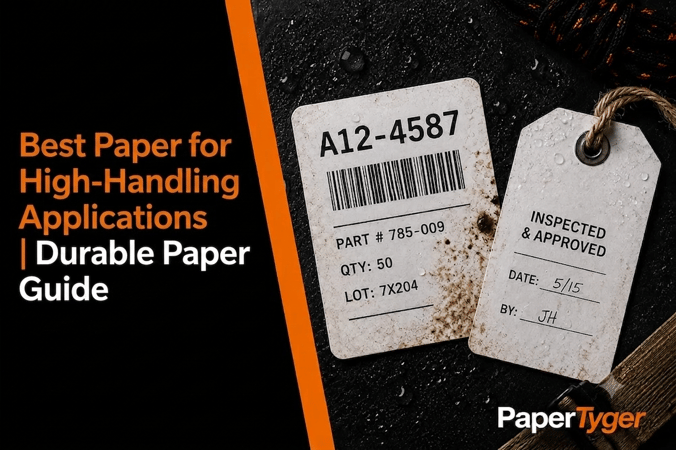
Not all printed materials are used the same way. Some are handled once and discarded. Others – such as menus, tags, packaging, and inserts - are used repeatedly, exposed to moisture, and subject to constant wear. In these environments, standard paper often fails quickly. The challenge is choosing a material that can withstand real-world conditions without complicating production.
What “High-Handling” Means in Practice
High-handling environments are defined by repeated use and environmental exposure.
This typically includes:
- Frequent physical handling (menus, tags, inserts)
- Exposure to moisture, spills, or humidity
- Friction from movement, stacking, or transport
- Repeated bending or folding
These conditions accelerate wear and expose the limitations of standard paper.
Key Performance Factors to Consider
When selecting paper for high-handling applications, four factors matter most:
1. Tear Resistance
Materials must withstand pulling, bending, and repeated use without failure.
2. Moisture ResistanceExposure to water or humidity should not compromise integrity.
3. Grease Resistance
In industrial, hospitality and food-related environments, resistance to oils is critical.
4. Print Compatibility
The material should run on existing print processes without requiring changes.
Balancing these factors is key to selecting the right solution.
Where Standard Paper Falls Short
Standard paper performs well in low-stress environments, but under high handling, it tends to:
- Tear easily
- Absorb moisture
- Degrade with repeated use
- Require frequent replacement
This leads to higher operational costs over time, even if the upfront material cost is lower.
Comparing Material Options
Standard Paper
- Low cost
- Easy to print
- Limited durability
Over - Laminated Paper
- Improved durability
- Additional production steps
- Risk of edge failure over time
Fully Synthetic Materials
- High durability
- Requires adjustments in printing and handling
- Less paper-like appearance
PaperTyger Durable Paper
- Balanced performance across durability and printability
- No secondary lamination step required
- Compatible with conventional print workflows
Where Durable Paper Fits Best
Durable paper is particularly effective in applications where:
- Materials are handled frequently
- Moisture or grease exposure is expected
- Print workflows need to remain simple
- A paper-like look and feel is preferred
- Cost-efficiency is a key consideration
Common examples include:
Hospitality and high-use print materials
- Restaurant menus and inserts
- Promotional materials used repeatedly
- Hotel door hangers
Labels, tags, and identification
- Product tags and labels
- Mattress law labels
- Event or temporary identification (e.g., racing bibs)
- Packaging components (e.g., soap wrappers)
- Durable envelopes and mailers used in shipping environments (see à PaperTyger for Envelopes & Mailers)
- Business cards
- Printed graphics and branded materials
From Performance to Practical Use
Choosing the right material is not just about durability - it’s about how that durability integrates into your workflow.
Durable paper provides:
- Consistent performance under handling
- Simplified production processes
- Reduced need for reprints and replacements
For many applications, this results in a more efficient, scalable and reliable solution over time.
Find the right PaperTyger durable paper for your application:
-
View Product Options → https://chasecorp.com/brands/papertyger
Please note: As of April 28, 2026, all PaperTyger® carton sales are managed through Wausau Coated Products, the sole authorized distributor for PaperTyger carton products.
What is the best paper for high-handling applications?
The best paper for high-handling applications is one that resists tearing, moisture, and wear while remaining easy to print and finish. Durable paper is often the most practical option because it provides strong performance in real-world conditions without requiring lamination or specialized materials.
FAQ:
What makes paper suitable for high-handling applications?
Tear resistance, moisture tolerance, grease resistance, and consistent printability are key factors.
Is over-laminated paper better for high-handling use?
It can improve durability, but adds production steps and may degrade over time at edges or folds.
Can durable paper replace laminated materials?
In many cases, yes. Durable paper can provide similar performance without requiring secondary lamination.
Are fully synthetic materials always the best option?
Not always. While highly durable, they can introduce complexity in printing and handling.
Can durable paper be used for menus and packaging?
Yes. It is commonly used for menus, tags, and packaging where durability and printability are both important.