Skip to content

  • There are no suggestions because the search field is empty.
HumisealLogoforBlogpage

HumiSeal Editor

HumiSeal Editor

Recent Posts

Automotive Conformal Coatings - Quick Guide for ADAS, ECU/BCU & Power Electronics

Posted by HumiSeal Editor on May 4, 2026 6:51:51 PM

What conformal coatings are used for automotive electronics?
Conformal coatings for automotive electronics must withstand heat cycling, vibration, contaminants, and long service life. Liquid chemistries such as acrylic, urethane, and silicone typically target 25–100 µm, while parylene is usually 5–25 µm for ultra-uniform protection. Select chemistry by environment and rework needs, then verify thickness, edge coverage, adhesion, and inspection to meet OEM quality and audit requirements.
 

Read More

Conformal Coating Thickness & Standards Guide

Posted by HumiSeal Editor on Apr 20, 2026 7:05:39 PM

What is the typical conformal coating thickness? Liquid coatings such as acrylics, urethanes, and silicones commonly target 25-75 µm dry film, while parylene is typically 5-25 µm. Final targets depend on chemistry, environment, and reliability requirements. Verify against applicable standards, the product TDS, and customer or OEM specifications. 

Read More

Selective Conformal Coating: Minimizing Overspray & Masking

Posted by HumiSeal Editor on Apr 14, 2026 3:45:39 PM

Masking eats minutes, and rework slows throughput. Most common application defects in selective coating come back to four variables you can control: chemistry behavior at edges, valve and programming choices, fixturing and board orientation, and inspection timing. Get those right, and overspray and creep typically reduce without slowing the line. 

The trade-offs are speed vs accuracy in a production line. Our goal is to help our customers find the right balance, we are flexible and we help customers make the right decisions for their process.

Read More

Next-Generation Conformal Coatings: Solving the Biggest Challenges in Modern PCB Protection

Posted by HumiSeal Editor on Mar 11, 2025 3:05:08 PM

In the rapidly evolving electronics landscape, ensuring the reliability and longevity of printed circuit boards (PCBs) is paramount. Conformal coatings have long served as a protective shield against environmental factors such as moisture, corrosion, and thermal stress. However, as technology advances, traditional conformal coatings face new challenges, particularly with modern PCB designs. 

Read More

Topics: conformal coating, Humiseal, Conformal Coating Process, Electronic Protection, Sharp Edge

How to Avoid Orange Peel Appearance in Your Conformal Coating

Posted by HumiSeal Editor on Oct 21, 2019 9:00:00 AM

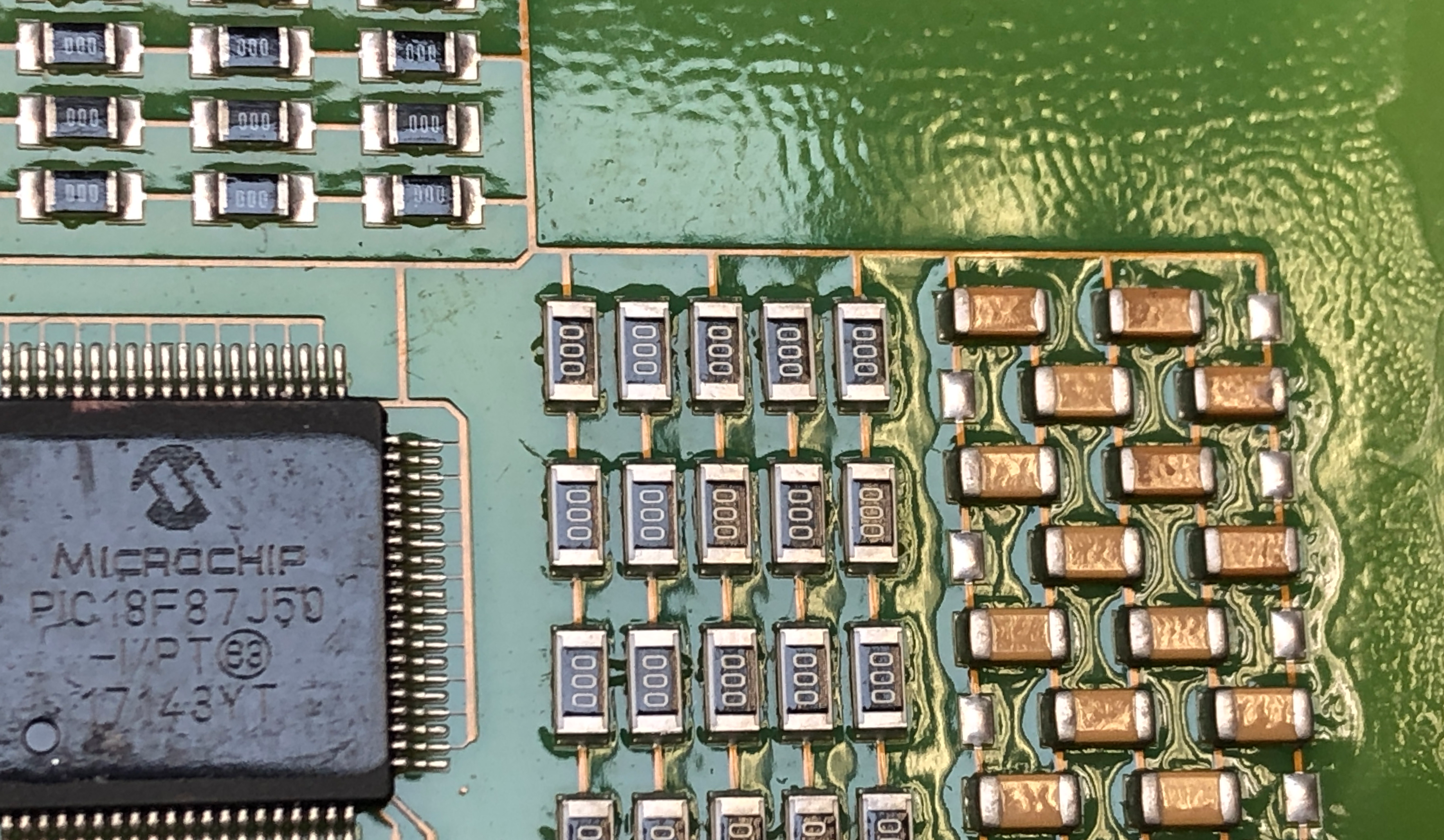
Have you ever seen your conformal coating look like the pictures above? It is a fairly common report to our technical support group. The appearance is often described as “orange peel” or sometimes “alligator skin.” We would like to offer you a basic explanation of this phenomenon, along with some simple approaches to avoid its occurrence or eliminate it when it appears.

What is orange peel and what is the cause?

In our experience, the uneven appearance that looks like the surface of your garden variety orange is almost always the result of exposing the coating to heat and airflow too quickly.

Read More

Topics: Conformal Coatings, Orange Peel

Subscribe Here!

Featured posts

Request FREE Sample

Posts by Topics

See all

Subscribe Here!

Featured posts

Posts by Topics

See all