Skip to content

  • There are no suggestions because the search field is empty.
HumisealLogoforBlogpage

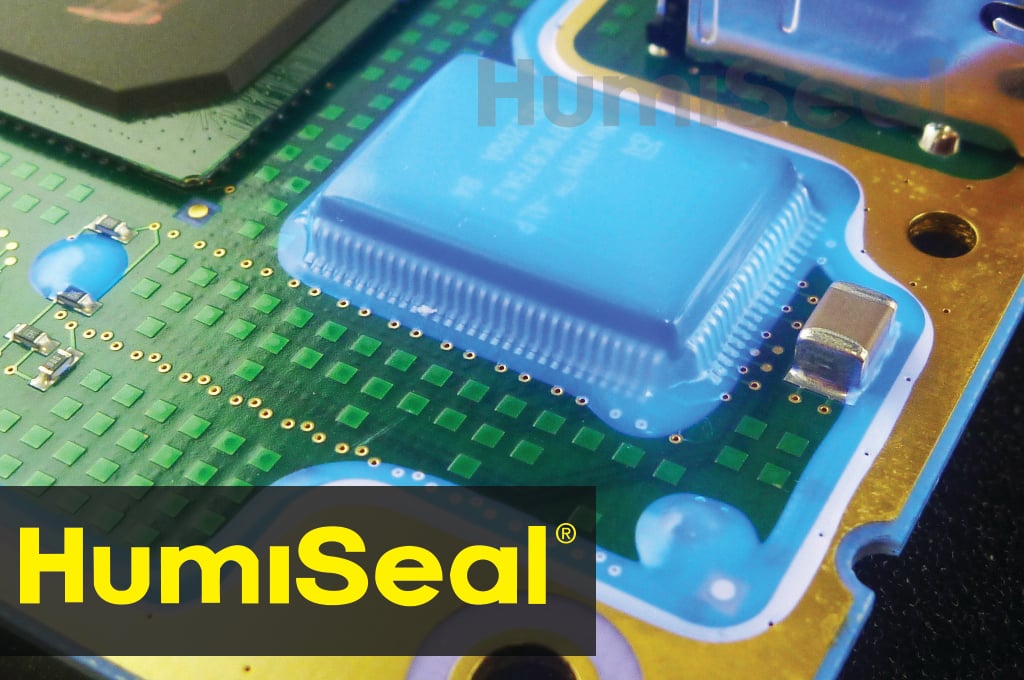
Counterfeit Conformal Coatings are Costly for Everyone

Posted by Chase Corp Editor on May 25, 2017 11:02:46 AM

The counterfeit of electronic materials is nothing new in the industry. There are numerous sources of these fraudulent practices and they come in various forms. However, the most important aspect is the cost that these forged coatings have on users.

It is known and well documented that in today’s electronics industry, there are some PCB board components that may come from manufacturer scraps, re-labeled unused parts, and removed components from used circuit boards. It has been reported that most of these electronic components are integrated circuits. 

Read More

Discovery of HumiSeal’s Ideal Customer

Posted by Christian Silahian on May 15, 2017 8:00:00 AM

Dear customer, thank you for many years of patronage and for your continuous support to HumiSeal conformal coating products. To celebrate you, the customer, we would like to share some findings of our internal survey. The objective was to find the characteristics of our ideal customer, those whom we have had the most success. 

Read More

Topics: Insider, News

Three Simple Steps to Calibrate UV Oven

Posted by Matt Eveline on Apr 6, 2017 6:01:00 AM

Have you ever wondered if your UV oven is performing up to specification?   Has your UV curable conformal coating come out of the oven tacky?  Today I’d like to take a few minutes to write about the importance of calibrating your UV oven to ensure you are getting the most out of our UV conformal coatings.  Setting up and optimizing your UV oven is a simple process that can be accomplished in three easy steps.  Here’s what you’ll need to get yourself started!

  • Conformal coating technical data sheet (TDS)
  • UV radiometer (calibrated and certified)
     

That’s it!  You only need these two items to successfully test and optimize your UV oven whether you are using a benchtop or inline UV curing system.  


Read More

An Effortless Approach to Eliminate Bubbles in Conformal Coating Through Solvent Type and Product Selection

Posted by Rafael Hernandez on Mar 27, 2017 12:06:51 PM

Hello Again!  The last time we discussed bubbles in conformal coating, I wrote how to resolve process related root causes.  There are other simple ways to reduce the amount of bubbles:

  • by varying the types of solvents used in a product
  • by using a product that contains a surface tension modifier, hence increasing the rate at which bubbles burst.

If you recall, most of the bubbles are basically solvent or air entrapped in the coating.  As you might expect, the air and solvent try to find their way up through the liquid to escape.  The problem is that the surface dries first, creating a thin skin that prevents those bubbles from escaping.  Therefore, the solution is to eliminate the bubbles in the coating prior to the skin formation.   In other words, use a solvent set and other surface tension reducing chemistries to accelerate elimination of bubbles.

Read More

How to Achieve Long Term Conformal Coating Thermal Shock Resistance – It’s All About Selection!

Posted by Nick Naumovic on Feb 27, 2017 7:01:00 AM

Figure 1: Thermally induced cracking in conformal coating

Does your conformal coating require long term thermal shock testing?   Do you struggle to overcome cracking and adhesion loss with your current conformal coating after 1000 thermal shock cycles?   With the drive for increasing functionality for end devices, and increased life cycles being placed on all electronic assemblies, the need to have materials endure more stringent testing becomes increasingly vital.  Necessary robustness to these stringent conditions force suppliers like HumiSeal to innovate new material solutions to address these requirements.

Read More

Synthetic Rubber Conformal Coatings, Industry's Best Kept Secret, Until Now!

Posted by Marie Kaing on Jan 26, 2017 10:23:41 AM

What is so special about synthetic rubber conformal coatings?   Why do many high reliability applications require synthetic rubber?  Would synthetic rubber be a better fit for your application?  Synthetic rubber copolymer provides higher operating temperature and exhibits superior mechanical properties compared to traditional materials. The products have been developed to withstand the demanding conditions in the most severe environments required in today’s applications.  Commonly used conformal coatings are acrylic, polyurethane and silicone.   Less known are synthetic rubber conformal coatings, however these have been used for many years and HumiSeal continues to develop new and improved varieties of this chemistry.


Read More

Topics: Synthetic Rubber Conformal Coatings

Easy Techniques to Abate Conformal Coating Wicking

Posted by Chase Corp Editor on Jan 11, 2017 12:24:26 PM

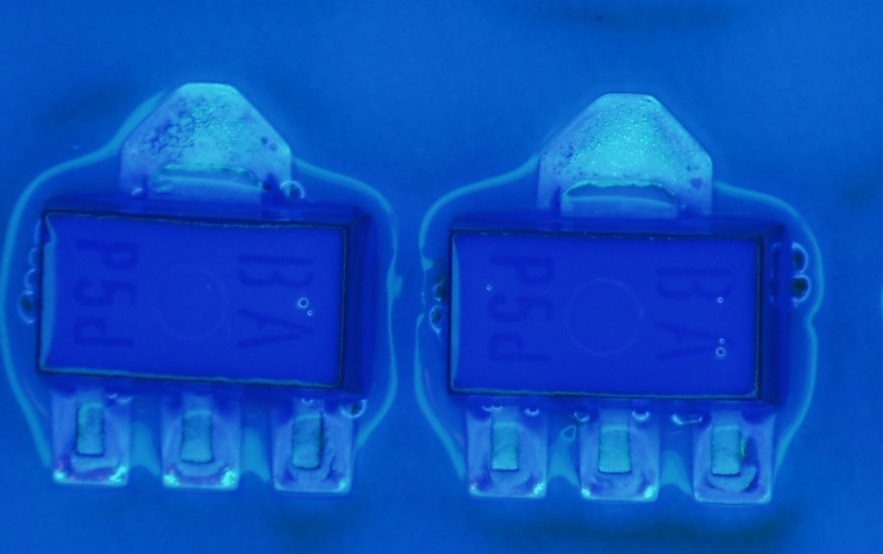
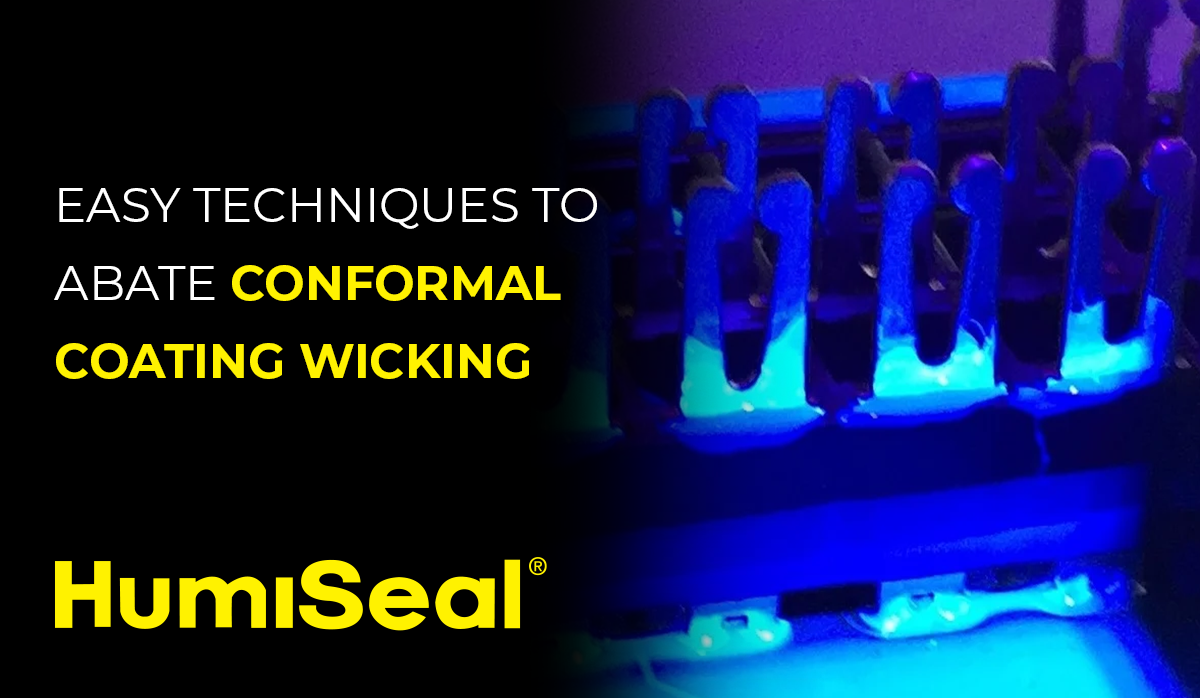
Have you ever experienced uncontrolled conformal coating migration?   Have you had to strip your recently coated boards because conformal coating wicked into non-desired keep out zones?   Wicking is a phenomenon caused by a combination of low surface tension coating, which is usually characterized by low viscosity, coupled with strong capillary forces generated by low standoff gaps possessed by the SMT process.   Wicking into connectors; onto grounding hole; or under sensitive components will create defects that will have to be reworked, as it may cause reliability concerns with the finished product, which we will describe in detail.   There are ways to either reduce and/or eliminate wicking issues through decisions made during preparation, application, and conformal coating selection.    

Read More

Topics: silicone conformal coating, Electronic Protection, Conformal coating benefits, Wicking

Simple Steps to Resolve Conformal Coating Wetting Problems

Posted by Monika Dybalska on Dec 15, 2016 3:22:10 PM

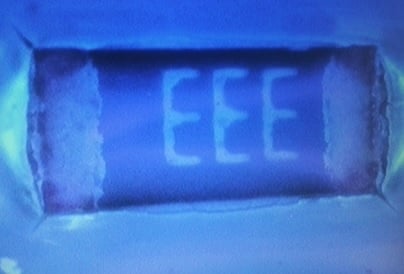
Does your conformal coating not wet properly? Do you struggle with craters, fish-eyes, or film separation? The culprit could be that the surface energy of your PCB is lower than the surface tension of the conformal coating.   The above defects are discussed frequently with customers on our technical support line, and any time we receive a technical enquiry regarding poor wetting or loss of adhesion, we ask “what is the surface energy of your substrate?” In this blog, we will explain surface energy, surface tension, and how to quickly troubleshoot defects resulting from low surface energy.

Read More

Topics: conformal coating, conformal coating application, Conformal Coating Troubleshooting

Potting and Conformal Coating with 2C51 Two-Part Silicone

Posted by Albert Hernandez on Nov 14, 2016 7:00:00 AM

Have you ever wondered if you can use the same material to pot or conformaly coat your electronics?  HumiSeal has launched a new fast curing, two-part silicone (Humiseal 2C51) that can be easily applied as a conformal coating or as a potting material.  This option allows users to standardize on one product for multiple applications.

Humiseal 2C51 is a high solids, low viscosity, fast curing product.  Humiseal 2C51 comes as a two-part kit.   Part A and part B are mixed with a 1:1 ratio to either encapsulate or conformally coat your electronics.  Part A and B are yellow and blue for easy verification of complete mix which is slightly turquoise.   When cured, 2C51 is trasparent even in high thicknesses.  Humiseal 2C51 is primarily used in high temperature applications where component stress relief is required.


Read More

Straightforward Explanation of the MIL-I-46058C Specification for Conformal Coatings

Posted by Chase Corp Editor on Nov 2, 2016 5:19:22 PM

During your selection of conformal coating you ran in to a specification that you have seen before but not fully understood, MIL-I-46058C.   Conformal coating choices are vast, but with so many available, how does a user pick the correct one? Are there minimum standards that define what a conformal coating is supposed to do? Thankfully, yes there are. This article will focus on one such standard: MIL-I-46058C.

The official title for the specification is MIL-I-46058C, Insulating Compound (For Coating Printed Circuit Assemblies). The standard serves as a material standard, used to evaluate and document that a particular coating meets a list of specific performance attributes (more on those later). The MIL-I-46058C was developed to define a uniform set of test methods and performance requirements for conformal coatings and gives users confidence that the material they select will perform.

Read More

Topics: Conformal Coatings, Conformal Coating Process, Mil-I-46058

Subscribe Here!

Featured posts

Request FREE Sample

Posts by Topics

See all

Subscribe Here!

Featured posts

Posts by Topics

See all